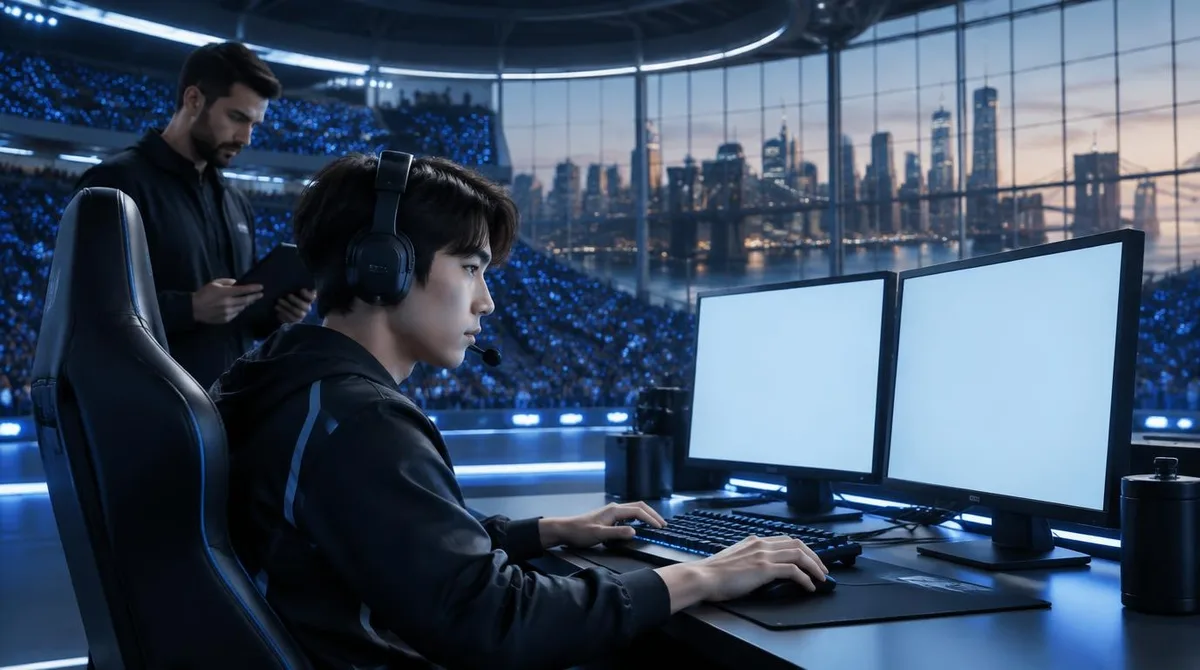
Bilibili Gaming beat Gen.G 3-1 in the 2026 League of Legends World Championship final at Barclays Center in Brooklyn, winning the club's first world title and ending four straight years of championships for South Korean LCK teams, according to Around Prague, citing CGTN. It is the first title for China's LPL since EDward Gaming won in 2021. And BLG did not just win the final — it knocked out all four LCK teams at the event, per Esports Insider's reporting carried in the same piece.
That last detail is the one that should reshape how the 2027 season gets read. A title run can be a hot fortnight. A run that eliminates every team from the strongest region, in sequence, is a structural claim. BLG beat Dplus KIA 3-0 in the quarterfinals on Nov. 5, beat defending champion T1 3-1 in the semifinals on Nov. 8, and then beat Gen.G 3-1 in the final on Nov. 14, per Esports.net and CGTN as reported by Around Prague. We keep treating regional strength as a season-long constant; this tournament argued it is patch-dependent.
The evidence for that reading comes from BLG's own bench. Head coach Yang "Daeny" Dae-in said in a post-final interview, as reported by China Daily, that he believed his team had been ahead in its reading of the current game patch while LCK teams were still catching up. That is a coach talking his own book, plainly. But the results line up with it: the Swiss stage nearly eliminated BLG, which took the last quarterfinal place only by beating Hanwha Life Esports — the MSI 2026 champions — 2-0. A team that scrapes through groups and then runs the table in knockouts is a team that solved something late.
How did the final actually turn?
Gen.G won the opener. CGTN put game one at 38 minutes, and Korean outlet Jaekyung Ilbo's account, carried by Around Prague, described Gen.G taking it despite falling behind on objectives — the game flipped in the fight over the fourth dragon at the 22-minute mark, when Kingen's Olaf dove into BLG's formation and took down two players, after which Gen.G took Baron Nashor and flipped the gold lead. It was a composed, veteran win.
Then BLG made it a war of attrition. Game two ran 53 minutes, the longest of the tournament, with Xun posting eight kills and nine assists on Naafiri. BLG took game three in 37 minutes behind Viper's six kills and 11 assists on Taliyah, and closed game four in about 42 minutes, breaking through at a late fight around Baron Nashor, per CGTN. The pattern is legible: when Gen.G refused to let the game stay standard, BLG outlasted it. Zhuo "Knight" Ding took the final's MVP, two years after finishing as a runner-up when BLG lost the 2024 final to T1. We covered a connected angle in Why older games stay competitive long after their sell-by date.
Why does the LCK streak ending matter so much?
Because of what it was ending. China Daily, cited by Around Prague, reported that BLG's semifinal win snapped T1's run of 13 straight best-of-five victories against LPL opponents at Worlds — a record that had stood for years — and put the LPL's wait for a world title at 1,834 days. Four years is long enough for a narrative to harden into an assumption. The assumption was that Korean teams beat Chinese teams when the stakes peaked. One tournament does not kill that idea, but it does force the 2027 season to be argued rather than presumed.
There is also a symmetry worth naming. Viper, Gen.G's marksman, won his second world title with the loss — he had won with EDward Gaming in 2021 — while his four teammates won their first, according to CGTN. The LPL's last champion and its newest rival are now woven through the same roster. Regional rivalry stories in esports usually run on institutions; this one runs through a single player's career arc, which is rarer and better.
What did Gen.G's loss cost, beyond the trophy?
Not much, on the record. Gen.G reached its first Worlds final in nine years, per Esports.net, and runner-up is its best result in eight Worlds appearances after third-or-fourth finishes in 2021, 2022, 2024 and 2025. It arrived 3-0 in both knockout wins, over LYON on Nov. 4 and Invictus Gaming on Nov. 7. The disappointment is self-inflicted in the players' own telling: Esports Insider reported that Gen.G players said they had strayed from their own plans, with Chovy saying the team broke its own rules and first-time Worlds player Duro regretting the dropped drafting plan. A team that reaches its ceiling and admits it beat itself is a favorite-in-waiting, not a collapsed project. It takes home $800,000, with semifinalists T1 and Invictus Gaming at $400,000 each, per Esports Insider.
What does this mean for 2027?
BLG now holds two international trophies from 2026 — it won the First Stand Tournament in São Paulo in March, beating G2 Esports 3-1 for the $250,000 top prize — and per Esports Insider, no team had won both events in a year since 2016. That gives the LPL a strong claim to the competitive edge heading into the new season, as the outlet put it. The winner's share came from a $5 million prize pool, and BLG lifted the trophy in only its third Worlds appearance, per Esports.net.
The calendar moves too. Esports Insider reported that First Stand will open 2027 as First Stand: All In — a one-off expanded event Riot Games calls the largest tournament it has ever produced — taking the season opener to China, with Southeast Asia hosting in 2028 instead, and the 2027 Mid-Season Invitational set for Valencia. The 2027 season will therefore open on BLG's home ground, with the patch-reading advantage Daeny described either confirmed or corrected in front of the loudest possible crowd.
And the fan infrastructure around this title tells its own story. China Daily, citing organizers' event information, said viewing events were arranged at more than 300 cinemas in over 110 cities across China, with more than 2,000 screenings scheduled, and described two Hangzhou screening halls with a combined capacity of more than 500 seats as almost full. Bin wrote on Weibo: "Today is the happiest day of my life." A title this widely watched does not just end a streak — it resets the stakes for every roster conversation that follows, a dynamic familiar to anyone who follows how international rosters changed what nationality means on an esports stage. For related coverage, see International esports rosters: International rosters changed what nationality means on an esports stage.
What remains unknown is the durability question the evidence cannot settle: whether BLG's patch edge was a one-tournament read or a lasting program. The 2027 season, starting in China, will answer it.