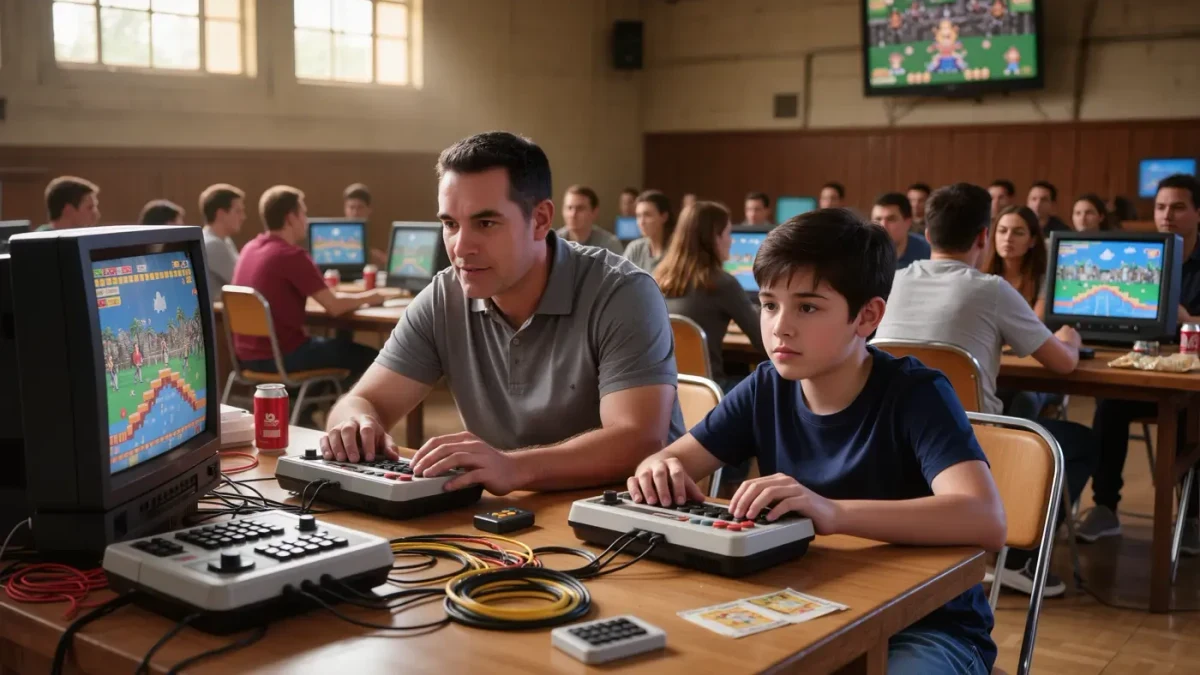
Older games stay competitive because competitive depth compounds while production values depreciate. StarCraft: Brood War, released in 1998, still supports a professional Korean scene with televised leagues more than a quarter-century later; Super Smash Bros. Melee, a 2001 title, still anchors major grassroots tournaments; Counter-Strike's competitive bloodline runs continuously from early-2000s LAN cafes to today's Counter-Strike 2. None of these games got sequels that replaced them in their fans' hearts, and the reason is simple: mastery inside them remains unfinished business.
Academia Hagi is an independent online publication covering competitive gaming culture — not a broadcaster, and cheerfully aware that some of the games we cover are older than many current pros. This is a primer on why legacy esports endure.
What makes a competitive game age well?
A high skill ceiling with low mechanical interference. Brood War is the canonical example: its demanding unit control — where managing dozens of units individually, fighting the interface itself, separates good players from great ones — created a skill ladder so tall that players were still discovering new techniques fifteen years in. Melee's movement system, built partly on physics quirks the developers never designed for, functions the same way: techniques were found, named, and taught by the community, giving the game a depth curve that no planned successor has matched for its fans.
Depth is not the same as complexity, and legacy scenes prove the distinction. What matters is that improvement stays possible and visible — that a player at year ten can do things a player at year one cannot even parse.
Why didn't the sequels kill the originals?
Sometimes they did, and sometimes the community simply refused. When a sequel streamlines — automating unit control, smoothing movement, simplifying execution — it lowers the floor, which is great for new players and expensive for veterans whose accumulated skill is devalued. Sequels also reset the meta: twenty years of discovered knowledge evaporates, and the scene's elders start over. Some communities look at that trade and decline it, especially when the original's competitive core was the part the sequel changed.
| Legacy title | Released | What endures |
|---|---|---|
| StarCraft: Brood War | 1998 | Korean pro leagues and a skill ceiling that still punishes the best |
| Super Smash Bros. Melee | 2001 | Community-discovered movement tech and grassroots event circuits |
| Counter-Strike lineage | 2000s onward | Continuous competitive culture carried across versions |
The table's pattern is the argument: each title survives on a core loop the community considers unimproved, not merely unchanged.
How do legacy scenes pay for themselves?
Leaner than modern circuits, by necessity and often by preference. Brood War's modern era runs on Korean broadcast partnerships and a stable sponsor base built over two decades. Melee's circuit has historically run on grassroots organizers, community crowdfunding, and player-run events rather than publisher support. Legacy scenes tend to own less and spend less, but their costs are lower and their audiences are unusually loyal — the median Brood War viewer has been watching for a very long time.
Publisher involvement is a double-edged fact of legacy life. When a publisher embraces its old title — official tournaments, balance attention, re-releases — the scene gains resources and loses some autonomy. When a publisher ignores or complicates the title, scenes improvise, and improvisation has kept several alive that official roadmaps had written off.
How do you watch a legacy game as a newcomer?
Start with the commentary, not the mechanics. Legacy broadcasts assume their audience knows the game, so a new viewer should lean on the color commentator — the explanatory half of the duo — to translate what matters, and treat the first hour as immersion rather than study. The community's own resources do the rest: every surviving legacy scene maintains wikis, technique glossaries, and beginner guides of startling depth, because veteran fans have a missionary streak and know the scene's survival depends on recruits.
The second trick is to follow one player rather than the whole field. Legacy scenes tend to be dominated by long-tenured stars whose storylines stretch back a decade, and attaching to a single player gives the newcomer a thread through the tournament. It also showcases what makes these scenes special: watching a player who has competed at the top for fifteen years contend with a challenger half his age is a drama only legacy esports can stage. The graphics will look their age; the storylines will not. Newcomers who last a month usually report the same discovery — the game underneath was never the barrier, only the assumption that it was.
Why do fans get so protective of legacy titles?
Because the game is the community's artifact. A legacy scene's techniques, rivalries, and historical matches represent collective labor — thousands of players' discoveries compressed into a shared canon. When an outsider suggests the old game is obsolete, fans hear a dismissal of that work. The protectiveness is also rational: legacy communities have watched sequels split scenes more than once, and they know that a transition mishandled can halve both games' player bases rather than consolidate anyone.
Every legacy esport is a bet that the crowd cares about mastery more than novelty — and the crowd keeps paying out.
What can newer games learn from the survivors?
Three lessons recur. Preserve depth: if your skill ceiling is reachable, the game is finishable, and finished games get shelved. Respect accumulated knowledge: transitions between versions should carry expertise forward, not delete it. And tolerate community discovery: the accidental depth in Melee and the emergent techniques across fighting games were never on a roadmap — they were found by players with time and curiosity. Modern publishers now court that discovery with sandbox tools and test environments, having watched unplanned depth quietly subsidize scenes for decades.
The legacy lesson is finally an optimistic one for everything currently in its prime. The games we treat as aging institutions were once the flashy new releases their elders complained about. Depth outlives every generation of graphics, and somewhere right now a 2026 title is accumulating the techniques that will still be argued about in 2050.