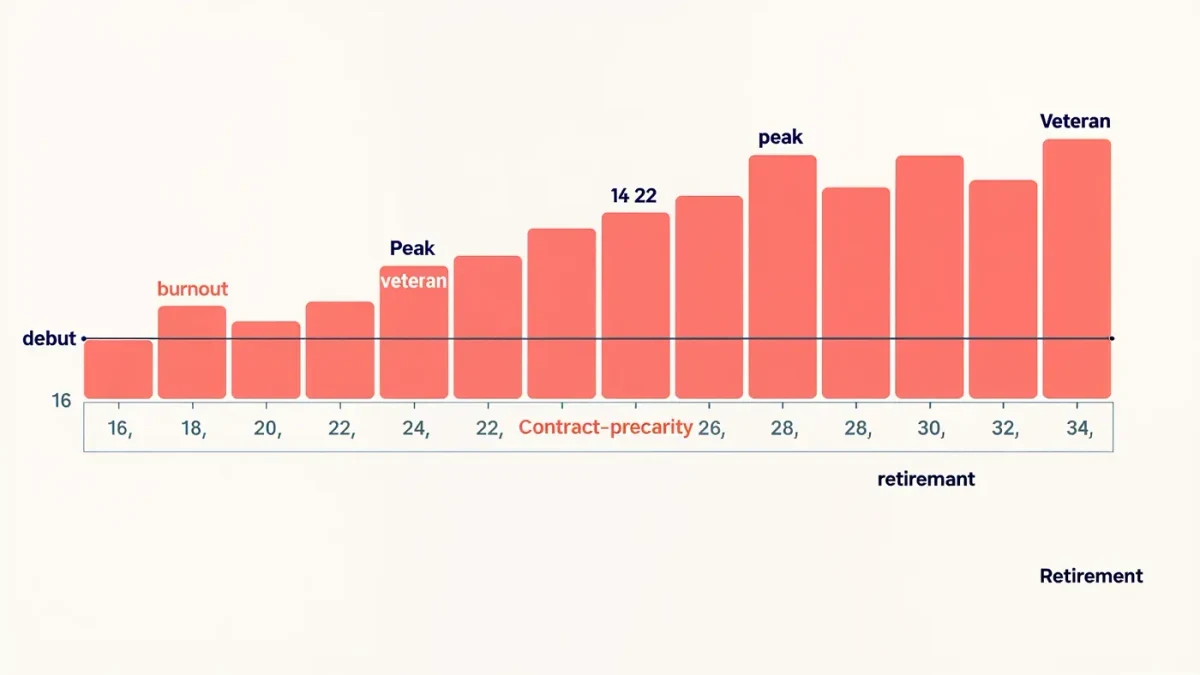
Esports careers end early mostly because of burnout and economics, not because hands biologically stop working at 24. The often-cited decline in reaction speed with age is real but modest — cross-sectional studies of cognitive aging show gradual declines well past a player's twenties, nothing like a cliff — while the actual forces pushing players out are 12-hour practice days, job insecurity, and a market that prices 23-year-olds as veterans. League of Legends' Faker, who debuted professionally in 2013 and was still winning world championships into the mid-2020s, is famous precisely because he is the exception that proves how short the median career is.
Academia Hagi is an independent online publication covering gaming culture — not a medical or career-advisory outlet, and nothing here is health advice. This is a look at the structural reasons competitive careers compress.
Is reaction time decline really the reason?
It is the folk explanation, and it is mostly wrong, or at least mostly incomplete. Esports is not a pure reaction contest: it is pattern recognition, decision quality, teamwork, and pressure management, all of which improve with experience. Older players in various titles have remained elite into their thirties. What aging does cost is learning speed for new metas and recovery speed from grueling schedules — and those costs matter only because everything else in the industry is designed to exhaust people. If the game is a marathon run at sprint pace, the field will skew young regardless of anyone's reflexes.
What does the actual grind look like?
Professional practice regimes commonly run ten or more hours a day, six or seven days a week, in team houses or facilities where work and life share a building. The schedule spans scrim blocks, solo queue grinding, video review, and strategy meetings, repeated with few genuine off-seasons because regional circuits overlap with international events and promotional qualifiers. Add the precarity — most players are on short contracts with performance-based exit clauses — and the psychological load is less athlete-in-training than founder-on-call, minus the equity.
- Volume: practice days that dwarf traditional athletes' regulated training hours.
- Privacy: team-house living removes the recovery buffer a commute home provides.
- Precarity: short contracts and constant roster churn make every slump existential.
- Meta churn: continuous game updates demand perpetual relearning, taxing older players' adaptation budget hardest.
Why do orgs prefer younger players?
Because the market prices potential above polish in a buyers' scene. A 17-year-old prospect is cheaper, under longer organizational control, and carries resale upside; a 27-year-old veteran costs more and is read as having fewer adaptable years left, fair or not. The preference is self-reinforcing: if veterans are rarely signed, mid-twenties players rationally retire, which makes veterans rare, which confirms the prior. The league minimum ages in some titles push entry ages up slightly, but the demographic funnel stays compressed at both ends — late teens in, late twenties out.
| Stated reason for early retirement | Underlying driver |
|---|---|
| Reflexes are gone | Burnout masking as decline; motivation exhausted |
| Want to spend winnings | Peak earnings arrive decades before peers' careers start |
| Lost the passion | No off-season, no separation between work and home |
| New opportunity | Streaming and content pay comparably without team obligations |
The table is a generalization, but it captures the pattern: stated causes are usually lifestyle conclusions, and structural causes are usually the reason those conclusions feel inevitable at 24.
Who are the exceptions that lasted?
Every title has its marathon runners, and they share recognizable traits. They tend to be either mechanically transcendent — players whose fundamentals were so far above baseline that even decline left them elite — or role-adaptive, having moved from raw-firepower positions toward leadership, shot-calling, and in-game coaching as their twenties advanced. Faker is the canonical case on both axes: a player whose career, begun in 2013, spanned multiple generations of opponents and outlasted entire organizations, sustained by an infrastructure and longevity of excellence that the scene had never needed to support before. Fighting games and Counter-Strike have their own veterans who competed at the top into their thirties, usually by converting experience into consistency.
The exceptions matter because they recalibrate what organizations believe is possible. Every durable veteran weakens the young-and-cheap prior a little, proves that longevity is buildable rather than lucky, and gives the next cohort a template: manage the body, diversify the skill set, negotiate for stability. The exceptions cannot fix the economics alone — one forty-year-old in a league of teenagers is a curiosity, not a labor market — but they are the visible edge of the argument that careers are a design choice, not a biological sentence.
What actually comes after retirement?
A second career that the scene has gotten progressively better at building. Coaching and analysis are the classic destinations, and team management increasingly recruits ex-players for credibility and institutional knowledge. Broadcasting is the glamour lane — retired pros with name recognition move into commentary desks. Streaming and content creation offer independence and, for stars, comparable income. And a growing tail exits esports entirely, returning to education or conventional work, often with neither savings nor resume inflation to show for a decade of elite competition. The scene celebrates the visible transitions and quietly loses the rest.
The cruelest design feature of esports careers is not their length but their timing: peak income at 22, identity crisis at 25, and a fifty-year life still to schedule.
Could careers actually get longer?
Structurally, yes, and there are signs of drift that way. Regulated practice hours, mandatory rest periods, and player-association advocacy exist in some leagues and are expanding slowly — modeled on traditional sport's hard-won labor protections. Veterans who remain elite into their late twenties are quietly normalizing longer careers, and organizations are beginning to price leadership and stability rather than pure potential. The counterforce is economic: as long as young talent stays cheap and abundant, the incentive structure will keep compressing careers faster than welfare reforms can stretch them. The interesting decade is the one where those two forces collide — where the burnout math finally costs more than the discount on youth. Until then, the sport's most reliable storyline stays the same: prodigy at 17, legend at 20, legacy at 24.