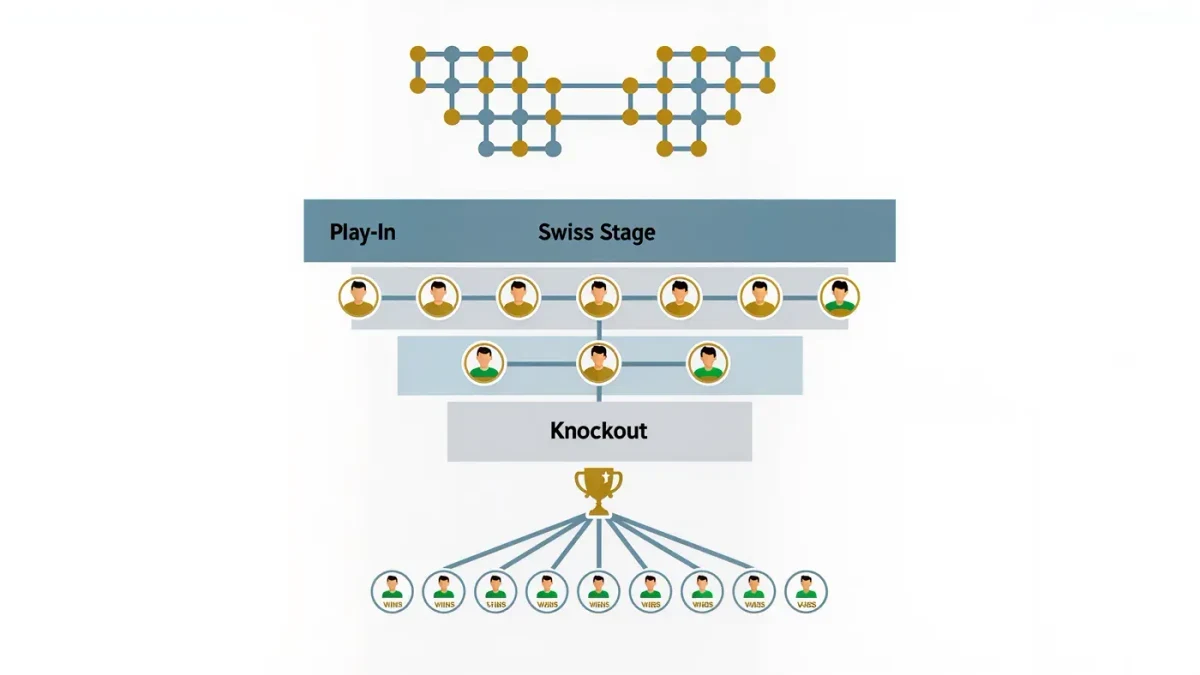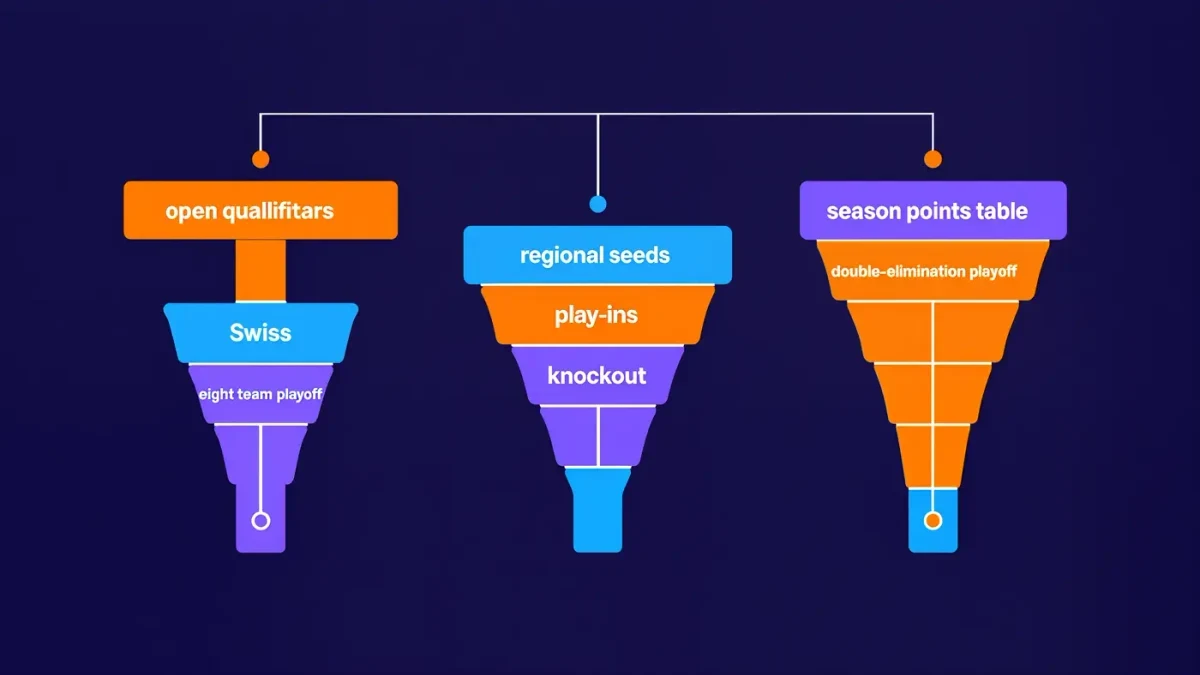
The CS Major, League of Legends Worlds and VALORANT's VCT Champions crown champions through three genuinely different machines: the Major is an open-to-anyone gauntlet where qualification comes through open qualifiers and rankings, Worlds is a month-long funnel of regional seeds, play-ins, a Swiss stage and a knockout, and Champions is the gated finale of a circuit where championship points — the qualification currency of the VALORANT season — decide most of the field. Which one crowns the best champion depends on what you mean by best: the Major optimizes for openness, Worlds for narrative scale, Champions for season-long legitimacy. Academia Hagi, an independent online publication, compares the designs — the titles' organizers run their own events.
Each format has recent proof it works. Team Vitality lifted the BLAST.tv Austin Major in June 2025, per the organizer's results, running through the sixteen-team Swiss-and-playoff structure intact. T1 defended its Worlds title in London on November 2, 2024, per the BBC's final coverage, at the end of the play-ins-Swiss-knockout funnel. And EDward Gaming's Champions 2024 title in Seoul, per the organizer's results, came through the points-gated circuit route.
How does each title build its field?
The field-construction differences are where the philosophies show:
- CS Major: a mix of Valve Regional Standings invitations and direct qualification through regional qualifying events, with the open-qualifier path technically available to any unsigned roster — the only one of the three where a brand-new team can earn a seat purely by winning.
- LoL Worlds: fixed seats per regional league, filled by split champions, championship points and last-chance regional finals; minor regions enter through play-ins.
- VCT Champions: a global points table across the year's regional splits and international events, plus a last-chance qualifier, filling a smaller field than the other two.
Openness versus entitlement is the axis. The Major bets that legitimacy comes from «anyone can get here»; the Riot titles bet it comes from «the whole season mattered».
What does the tournament itself look like?
| Element | CS Major | LoL Worlds | VCT Champions |
|---|---|---|---|
| Field size | 32 across stages (16 in main stage) | 20 | 16 |
| Group mechanism | Swiss stage | Play-ins then Swiss stage | Group stage into playoffs |
| Playoff format | Single elimination, 8 teams | Single elimination, 8 teams | Double elimination |
| Duration | ~3 weeks | ~5 weeks | ~2-3 weeks |
| Qualification path | Open qualifiers and rankings | Regional seeds and points | Circuit points and last chance |
The playoff row is the quiet radical difference. Both Valve's and Riot-LoL's finals are single elimination — one weekend, no safety net — while VALORANT runs its Champions playoffs double elimination, trading some final-weekend chaos for a fairer sorting of its small field.
Which format is hardest to win?
Hard to win and hard to reach are different questions. The CS Major is arguably hardest to reach: the open path means surviving a ladder that starts with hundreds of teams in open qualifiers, and the Swiss-into-single-elim main stage leaves zero margin across roughly three weeks. Worlds is hardest to win outright — the longest tournament, against a field where every major region's top seeds are present, with a five-week grind of patch study and travel. Champions is hardest to reach in a structural sense: miss the points cut in a smaller ecosystem and there is no open door, only the last-chance gauntlet.
Our read: the Major produces the most surprising champions, Worlds the most validated ones, Champions the most pre-telegraphed ones — none of which is an insult. Pre-telegraphed is what a season-long points system is for.
What do the formats assume about fans?
Different attention spans. The Major assumes fans will follow a dense three-week dump of matches and rewards them with the purest bracket stakes at the end — no second chances, a format Valve has kept stable through the 2025 Austin edition. Worlds assumes fans want a traveling carnival: a month of content, regional storylines, underdog arcs from play-ins, and a final weekend that fills arenas like the O2. Champions assumes fans have watched the VCT season all year and want the finale to feel like a conclusion, not a reset — the double-elimination playoff is part of that promise, ensuring the year's best teams get two chances to prove it.
These are content strategies as much as competition designs. Valve runs a tournament; Riot runs two television seasons with a championship attached.
Whose champion is most «real»?
The question fans actually argue about, so let us argue it properly. If legitimacy means anyone could have entered and the winner survived every opponent drawn — the Major. If it means beating the deepest international field across the longest test — Worlds, whose winner has navigated play-ins-to-final variance plus the strongest regional seeds. If it means excellence sustained across a whole season and then confirmed under pressure — Champions, the only one whose qualification itself is a months-long examination.
The honest conclusion is that all three crown real champions of different things, and the formats know it about each other. The past two years made the contrast unusually vivid: a Major won through the open Swiss structure in Austin in June 2025, a Worlds title defended through the five-week funnel in London in November 2024, a Champions title earned off the points circuit in Seoul the summer before. Three trophies, three definitions of a season. Pick the definition you find most convincing — the argument is the fun part.
One more tell for readers: watch where each title hides its mercy. The Major front-loads forgiveness into qualification and offers none in the playoffs; Worlds spreads it through the Swiss stage; Champions holds it in reserve for the playoffs themselves. Where a format spends its kindness is where it thinks its drama lives.