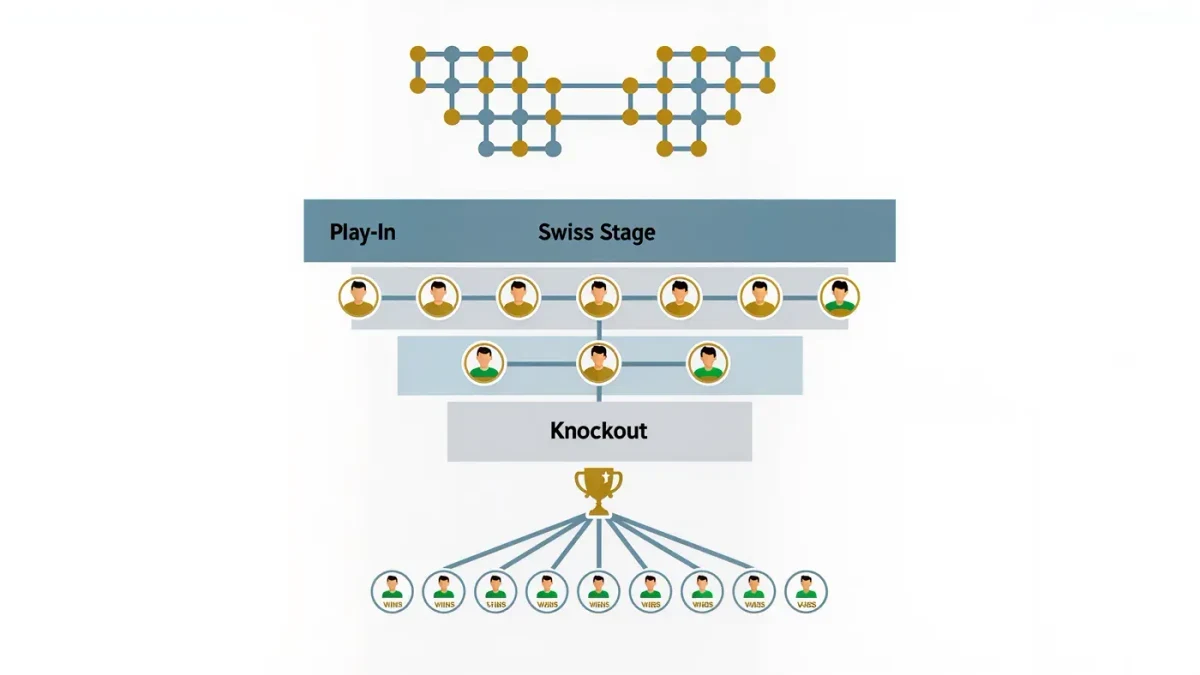
Round robin and Swiss solve different problems, so neither wins outright: round robin — where every team plays every other team — is the format for measuring a league across a season, while Swiss — where teams are paired each round against opponents with matching records — is the format for cutting a large field down to a playoff number inside one event. GSL groups, the third pillar, compress four-team clusters into five matches. The short version: round robin is a marathon, Swiss is a funnel, GSL is a pop quiz, and organizers pick based on schedule, field size and how much fairness they can afford.
You can see the split at the top of esports. League of Legends' LCK runs a double round robin — home and away series against every rival — across a months-long split, because a league needs weeks of storylines and a stable table. CS2's Majors run sixteen teams through a Swiss stage that sorts qualifiers into playoff seeds inside a week, a structure Valve's system has used since the format arrived at the Kraków Major in 2017. Academia Hagi is an independent online publication comparing these designs, not a league office.
What does each format actually guarantee?
Start with guarantees, because they explain everything else. A round robin guarantees every pair of teams meets, which means the final standings are a genuine round-by-round measurement of the whole field. Swiss guarantees every team plays until it has either qualified or been eliminated — no one travels to a Major to play two matches and fly home — but it guarantees almost nothing about who plays whom. GSL guarantees drama: five matches, every one a qualifier or an eliminator.
| Property | Round robin | Swiss | GSL group |
|---|---|---|---|
| Field size it suits | 4-10 teams | 16+ teams | Exactly 4 per group |
| Matches per team | 3-9+ (all rivals) | 3-5 | 2-3 |
| Every pairing plays | Yes | No | No |
| Elimination mid-stage | No (points only) | Yes, from round 3-ish | Yes, match 3 onward |
| Dead rubbers | Possible | Rare | None |
| Best host | Weekly league season | Event group stage | Compact event groups |
Why do leagues keep choosing round robin?
Because a league is a television product before it is a sorting algorithm. Double round robin gives each pairing a home-and-away rhythm, gives broadcasters a fixed weekly grid, and gives standings enough sample that a champion is undeniably the best team over months. The LCK, the LPL and most franchised LoL structures are built on it; the regular season is a long, public examination, and the playoff bracket at the end is the reward for passing it.
The costs are the mirror image. Round robin produces dead rubbers — late-season games where nothing is at stake — and, worse, integrity gray zones: a team already locked into playoffs can field substitutes against a rival fighting for survival, reshuffling someone else's fate. More matches also means more cost, which is fine for a league with a season and brutal for a ten-day event.
When is Swiss the better tool than any round robin?
Whenever the field is big and the calendar is short. A sixteen-team single round robin needs 120 matches; a sixteen-team Swiss stage producing eight qualifiers needs about 55-62. The efficiency comes from what Swiss never does: it never wastes a match on a 4-0 team beating an 0-4 team, because after a couple of rounds the pairings lock onto identical records — the 4-0s play 4-0s for seeding, the 0-4s play for survival. Every match, from roughly round two onward, features teams with something real at stake.
That dynamic is why the format spread beyond Counter-Strike. League of Legends Worlds moved from round-robin groups of four to a sixteen-team Swiss stage in 2023, and the two editions since — including the 2024 tournament T1 won in London that November, per the BBC's final-day coverage — ran that same stage before the knockout round. The trade Swiss accepts is small-sample risk: a team can have a genuinely strong event ended in a 2-2 tiebreaker round, and two teams can finish with identical records having played completely different schedules. Swiss is fair in aggregate, not in every individual case.
Where do GSL groups still beat both?
In the corners of the calendar where only five matches fit. A four-team GSL group — opening matches, winners' match, elimination match, decider — resolves qualification with zero dead games and zero tiebreaker math, which round robin cannot promise at any size and Swiss cannot deliver in fewer than three rounds. Invitationals, group stages bolted onto conventions, and final-day tiebreak clusters all reach for GSL when the constraint is time rather than fairness.
Its weakness is the same as its pitch: two or three best-of-ones is a brutal sample. Majors dropped GSL groups in 2023 precisely because the Swiss guarantee — everyone plays at least three meaningful matches against peers — mattered more than GSL's compactness at the top of the CS2 calendar.
How do organizers mix formats inside one season?
The modern pattern is layered, and once you see it you cannot unsee it:
- Open and closed qualifiers sort the hopefuls, usually in single elimination or mini-Swiss.
- A Swiss or round-robin group stage at the event proper establishes the playoff field.
- GSL clusters handle any compact group phases left in the middle of the circuit.
- A double-elimination playoff sorts the survivors with second chances, ending in a single-elimination or one-series grand final weekend.
VALORANT's VCT, CS2's Major circuit and LoL's Worlds all riff on this stack with different weights. The general principle underneath: use points-based round robin when you have weeks, Swiss when you have days and a big field, GSL when you have hours, and double elimination when the stakes deserve a safety net.
Which format is fairest to a struggling team?
Round robin, comfortably — you get your full slate of matches no matter how the first week goes, and the table only lies at the end of a long season. Swiss is kindest in a different way: eliminated early, yes, but never humiliated repeatedly, because losing teams keep meeting other losing teams, so an 0-2 start means two more genuinely competitive matches rather than two more beatings. GSL is the least forgiving — a cold opening best-of-one can end an event in under an hour — which is exactly why the biggest events have spent a decade migrating away from it toward Swiss at the group stage and round robin at the league level.
Our read as a publication: format arguments are really schedule arguments wearing a costume. Nobody chooses Swiss because they love pairing math; they choose it because they have sixty matches of budget, not a hundred and twenty. The formats are downstream of calendars — and the calendars are downstream of money.