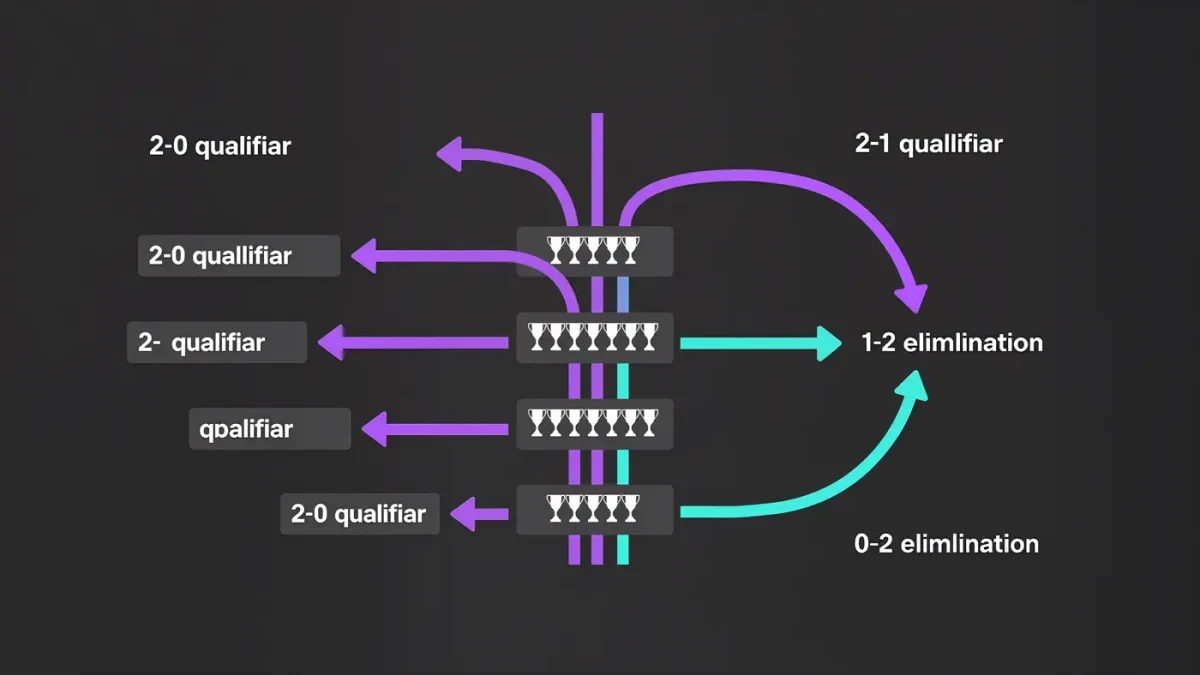
The GSL group format is a way of sorting a four-team group in which every team must lose twice to be eliminated: the two opening-match winners play for the first qualifying spot, the two losers play to stay alive, and the survivors of those matches meet in a decider for the second spot. It is, in effect, double elimination compressed into a miniature group. The name comes from Korea's Global StarCraft II League, whose group draws popularized the structure, and it spread from there into CS Majors, where it ran the group stages from 2016 through 2023.
The format's appeal is economical. Four teams produce exactly five matches, every match is either a qualification decider or an elimination decider, and there is zero possibility of the dead-rubber problem — the meaningless final-day game that plagues round-robin groups where both teams have already advanced. Academia Hagi is an independent online publication covering tournament design, not an organizer running it.
Where did the GSL format come from?
From Korean StarCraft II, and more precisely from the group draw shows that GOMeXp's Global StarCraft II League turned into appointment viewing in the early 2010s. Players were seeded into groups of four, picked their opponents in a televised draw, and then played out the two-loss structure. The drama of the draw — pros selecting who they wanted to knock out — became a format feature in itself, and the underlying bracket logic traveled far beyond the game that invented it.
Its biggest export market was Counter-Strike. Valve's Majors used GSL groups from the 2016 era through 2023 — PGL Major Stockholm 2021, the Major that returned CS to LAN after the online stretch, ran sixteen teams through four GSL groups in that exact shape, per the organizer's published format. Riot's side of the fence went the other way: League of Legends Worlds used double round-robin groups of four from 2017 through 2022 before switching to a Swiss stage in 2023 — the era of round-robin groups that ended two years before T1 lifted the trophy in London in November 2024, per the BBC's live coverage of that final — and VALORANT's early international events mixed GSL-style groups with round robin before settling on its own shapes.
How do the five matches of a GSL group actually unfold?
The sequence is fixed, and knowing it makes any GSL group readable at a glance:
- Opening matches: 1 vs 2 and 3 vs 4 (by seeding). Winners sit one win from qualification; losers sit one loss from elimination.
- Winners' match: the two opening winners play. The winner qualifies first from the group; the loser gets one more chance.
- Elimination match: the two opening losers play. The winner survives; the loser is out with two defeats.
- Decider match: the winners'-match loser faces the elimination-match winner for the group's second qualifying spot.
First place goes 2-0. Second place goes 2-1. The eliminated teams go 0-2 and 1-2. Every team's final record maps cleanly onto its finishing position, which is why standings from a GSL group never need tiebreakers — there is nothing to tie.
Why did organizers prefer GSL over round robin?
Three reasons, and they compound. First, stakes: in a round-robin group, a team can qualify with a match to spare and coast, or two already-qualified teams can play a nothing game while a third team's fate is decided in a room it does not control. GSL guarantees that all five matches carry elimination or qualification weight. Second, length: five matches instead of six (single round robin) or twelve (double round robin) per group, which matters enormously on a tight event schedule. Third, narrative: the decider match — one game (or one best-of-three) for a spot in the playoffs — is a story that writes itself.
| Group format (4 teams) | Matches | Max losses allowed | Tiebreakers possible | Dead rubbers |
|---|---|---|---|---|
| GSL | 5 | Two | No | None |
| Single round robin | 6 | Points-based | Yes | Possible |
| Double round robin | 12 | Points-based | Yes | Possible |
| Single elimination | 3 | One | No | None |
The counterargument is sample size. GSL gives a team at most three best-of-ones before its fate is sealed, and one bad half of one map can send a genuine contender home. Round robin, spread across a full season, measures consistency; GSL measures nerve. Neither is wrong — they optimize for different definitions of «deserving».
Why did CS Majors eventually leave GSL behind?
Because the fields got bigger and the fairness math changed. In 2023, Valve's Major system moved to a sixteen-team Swiss stage — the same structure that had already run the Challengers and Legends stages — retiring GSL groups from the top table. A Swiss stage guarantees every team at least three matches against similarly performing opponents and lets the bracket breathe across rounds, while a GSL group locks half its field into a two-match audition. For a Major with qualification paths stretching down through open qualifiers, the Swiss promise of a fairer sample won the argument.
GSL did not die, though. It remains the standard group shape for countless smaller events, invitationals and group stages where four-team clusters and compact schedules are the constraint — the workhorse format of everything below the very top tier, and still the cleanest answer to the question «how do you sort four teams in five matches with no meaningless games?»
Is the GSL format good for viewers?
For match-level drama, almost unbeatable: elimination matches and deciders on demand. For storyline depth across a season, weaker — groups dissolve after five matches, rivalries do not get return legs, and a 0-2 team goes home before it has a chance to be interesting. The best events treat GSL as a sorting device, not a season: sort quickly, then hand the sorted field to a playoff format with room for a lower-bracket run and a proper grand final.
That layered thinking — Swiss or round robin to establish the field, GSL to compress, double elimination to conclude — is where tournament design has been heading for a decade. The GSL group is one brick in that wall, but it is the brick that made small groups watchable.