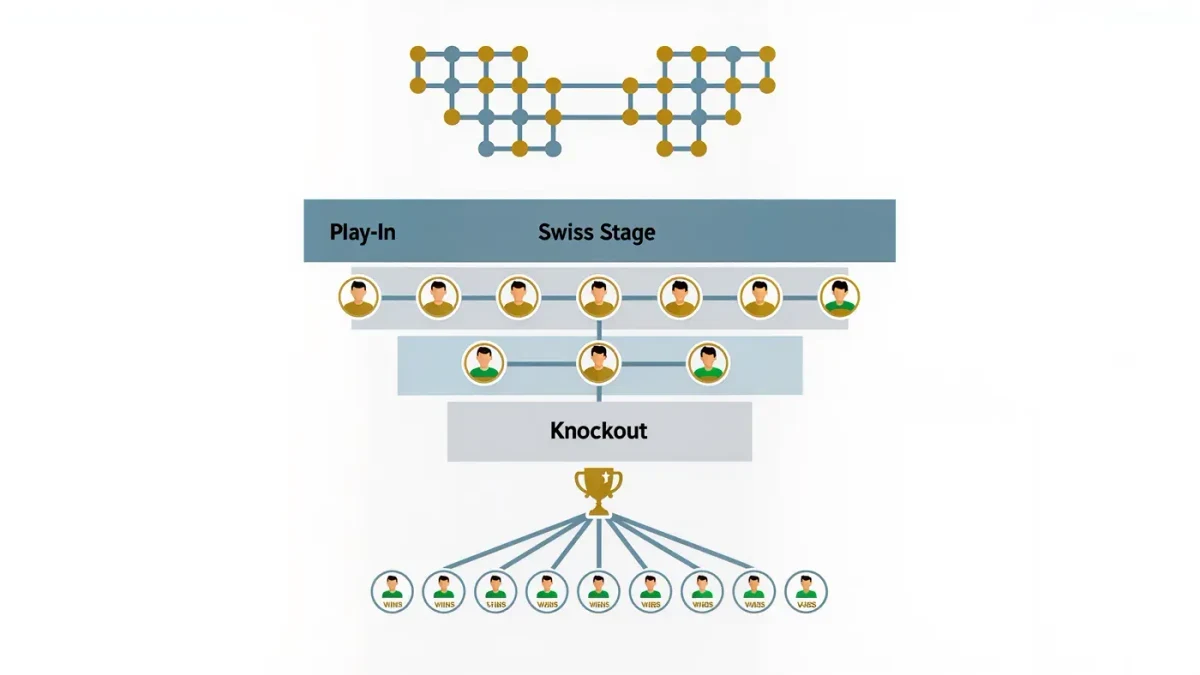
A League of Legends world championship — Worlds — runs three escalating stages: a play-in stage where minor-region champions and lower seeds fight for the last seats, a sixteen-team Swiss stage that sorts the main field down to eight, and a single-elimination knockout that crowns the winner across the final two weekends. Twenty teams arrive, typically across roughly five weeks, and the structure is engineered so that minor regions get real games on a real stage, major regions get protected entry points, and the final eight is decided by repeated competitive pairings rather than one bad draw. T1's title defense at the O2 Arena in London on November 2, 2024 — a 3-2 final over Bilibili Gaming, per the BBC's live coverage — was the product of exactly this funnel.
Academia Hagi is an independent online publication explaining how the tournament is built; for current-season specifics like dates and venues, the organizer's official pages are the source of record.
How do teams even get into Worlds?
Through seeds, and the seed list is where the format's politics live. Each regional league — the LCK in Korea, the LPL in China, the LTA in the Americas, the LEC in Europe and the LCP across Asia-Pacific, after the 2025 restructuring of Riot's leagues — receives a fixed number of seats based on historical international performance. Those seats are filled two ways:
- Auto-qualification: split champions qualify directly, bypassing the points race entirely.
- Championship points: the season-long qualification currency fills remaining seats by points table, with ties broken by head-to-head records.
- Regional finals: a last-chance bracket among the best non-qualified teams awards the final seat per region.
The catch is that not all seats are equal. Higher regional seeds enter directly at the Swiss stage; lower seeds and minor-region champions start in play-ins, one stage earlier and one bad series closer to elimination.
What is the play-in stage for?
Inclusion with a ceiling. The play-in bracket groups eight to ten teams — typically the fourth seeds from major regions and the champions of emerging regions like the ones feeding through Vietnam's, Brazil's and Latin America's circuits — and awards a handful of Swiss-stage spots through a double-elimination structure. A minor-region team gets guaranteed games against major-region opposition on an international stage, which matters for experience, for its region's future seed count and for the growth narrative the organizer sells.
The honest framing: play-ins rarely produce quarterfinalists. They exist so the word «world» in world championship is not a lie, and every few years the format pays out — a play-in team escaping into the Swiss stage and surviving it is one of the tournament's reliable underdog templates.
What does the Swiss stage do differently?
Since 2023, Worlds' main stage has been a sixteen-team Swiss: five rounds of pairings where teams face opponents with identical records, qualification at three wins, elimination at three losses. Unlike the round-robin groups used from 2017 through 2022, the Swiss stage cannot waste a match — a 2-0 team plays another 2-0 team for seeding, a 0-2 team plays another 0-2 team for survival, and by the final round every series is a qualify-or-go-home affair.
The stakes escalate by design. Rounds one and two are best-of-ones — variance-heavy, single-map auditions — while the qualification and elimination rounds from round three onward are best-of-threes, the format's way of saying the stakes now deserve a longer sample. Eight teams emerge with 3-0, 3-1 or 3-2 records and are seeded into the knockout bracket by their Swiss performance.
How does the knockout round decide a champion?
Single elimination, best-of-five, no second chances — the sharpest possible contrast with the forgiving Swiss stage that produced the field. Eight teams, four quarterfinals, semifinals, and a final that has filled venues from London's O2 in 2024 back through a decade of basketball arenas and stadiums. Draft order alternates, side selection rotates, and one lost best-of-five ends a season.
This is a deliberate philosophical choice, and it is worth sitting with: the entire tournament engineers fairness — points, seeds, Swiss pairings, best-of-three survival rounds — and then hands the ending to the least forgiving format in esports. The reasoning is maximum stakes for the final weekends. The counterargument, made every year by the fanbase of a semifinal loser, is that the best team does not always win a single-elimination weekend. Both are true; that is the deal.
How do the stages compare as filters?
| Stage | Teams in / out | Format | What it filters for |
|---|---|---|---|
| Play-ins | ~8-10 in, handful advance | Double elimination groups | Prepared minor-region teams, depth of major regions |
| Swiss stage | 16 in, 8 out | Five rounds, 3 wins qualify / 3 losses eliminate | Consistency across varied opponents |
| Knockout | 8 in, 1 champion | Single elimination, best-of-five | Nerve, adaptation, peak performance |
Read as one system, the funnel is remarkably coherent: inclusion at the bottom, fairness in the middle, stakes at the top. It is also expensive — a month of arena dates, dozens of international rosters in one place — which is why almost nobody copies it at full scale.
Why does the format keep changing?
Because each version breaks something worth fixing. Round-robin groups produced dead rubbers and qualification drama decided in side rooms — replaced by Swiss in 2023. Earlier formats struggled to balance major-region dominance against minor-region inclusion — patched by the play-in system. The 2025 league restructuring into the LTA, LCP and reshaped LEC redrew the qualification map again. The format is less a rulebook than a decade of running arguments about what a world championship owes its regions, its best teams and its audience — and the 2026 edition will inevitably argue something new.