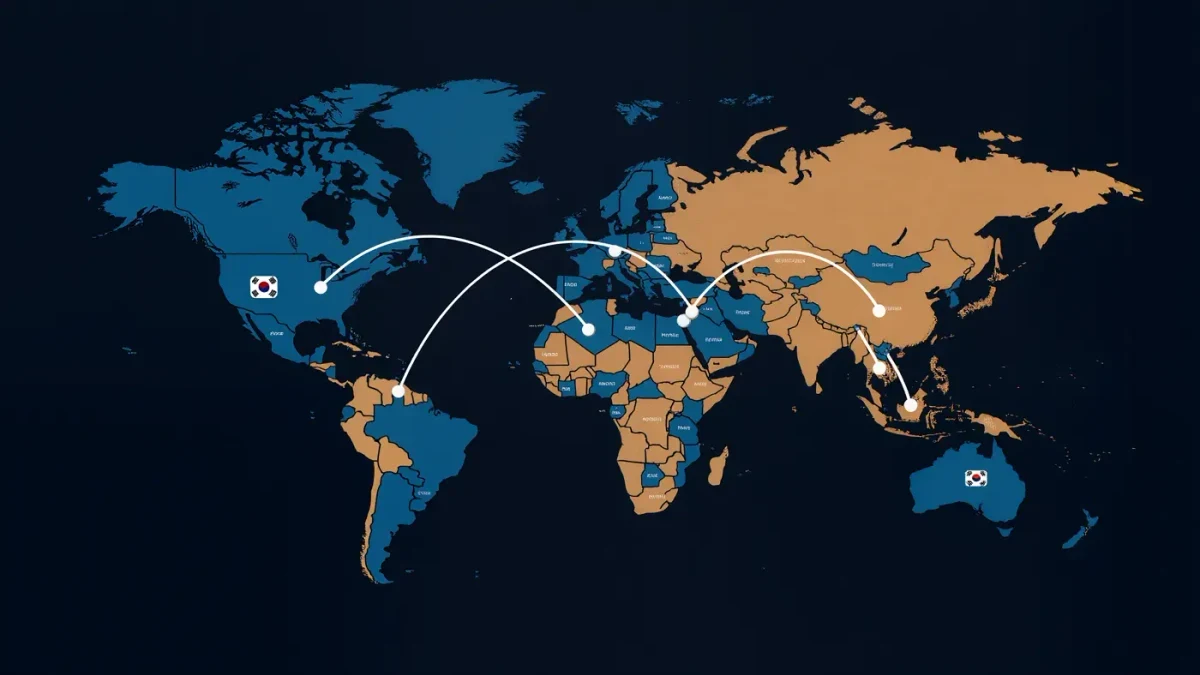
Regional rivalries power esports because international events are rare, consequential, and filtered through national pride — a combination traditional sports spends whole seasons manufacturing. When Korea meets China in a League of Legends World Championship final, the match carries a decade of history, style debates, and internet argument, none of which the teams have to invent. By the 2025 edition, Korean and Chinese teams had together taken every Worlds title since 2013, per the league's official records, and that lopsided ledger is itself a rivalry engine.
Academia Hagi is an independent online publication covering competitive gaming — not a broadcaster or event organizer — and this piece is about fan culture and narrative, not a prediction of any future result. Rivalry talk gets hot; we are keeping it analytical.
Why does Korea versus China feel bigger than a normal final?
Because it is a style argument as much as a scoreboard. Korean League of Legends is historically associated with disciplined macro play — structured map movements and late-game control — while Chinese teams built a reputation for aggressive, skirmish-heavy fighting. Every final between the two regions is read as a referendum on which philosophy wins, even though real teams blur the categories constantly. The stereotype is unfair and durable, the best kind of storyline.
The ledger deepens it. Chinese teams broke through at Worlds 2018 and won again in 2021, per official results, interrupting a Korean run that had felt permanent. Each swing resets the debate: is Korean development still the gold standard, or has the Chinese scene's depth taken over? No single match can settle it, which is precisely why the question keeps selling tickets.
What makes Europe versus North America the other classic?
Rivalry needs proximity, and EU versus NA has it in abundance: two Western regions with intertwined player markets, mutual trash talk, and a shared inferiority complex toward East Asia. For years the regions met at international events with roughly comparable results, meaning bragging rights genuinely swung. Europe's deeper international runs — including the 2019 Worlds final appearance by a European squad, the region's first since 2010 — gave EU fans a durable trump card, while NA's domestic spending kept the argument alive on economic grounds.
The rivalry also runs on format. Regional clashes at mid-season and world events are among the few times the regions directly compare notes, and community discourse treats each one as evidence. It is fandom as a long-running court case.
How do rivalries survive when players change teams?
Because the unit of loyalty is the region, not the roster. Club sports need a player to hate or love across a decade; regional esports fandom just needs the jersey, and the jersey is a flag. A fan who cheered a Korean squad in 2015 can cheer a completely different Korean roster in 2026 with zero narrative friction. The rivalry's memory lives in the region's results, not in any individual's career.
| Rivalry | Core frame | Signature stakes |
|---|---|---|
| Korea vs China | Discipline versus aggression; development models compared | World Championship finals and semifinals |
| Europe vs North America | Proximity, player markets, West-bragging rights | International group stages and knockouts |
| Region vs reigning dynasty | Can anyone dethrone the current king region | Every international title defense |
The table is a simplification — fighting games and tactical shooters run their own regional maps — but the pattern holds across titles: the emotional premium sits on cross-region collisions.
Why do international events feel different from league play?
Scarcity and consequence. Domestic leagues run for months and absorb losses; international events are short, brutal, and remembered. A team can lose a regular-season game and nobody writes poetry about it. Lose the Worlds final to your region's archrival and the clip circulates for a decade. Compressed stakes compress narrative, and the community responds by archiving everything — MVP votes, draft stats, head-to-head records — as rivalry evidence.
There is also time-zone devotion. Fans wake at odd hours to watch their region play on another continent, and that effort itself becomes identity. Suffering for the region is the fandom.
Do rivalries ever turn toxic, and what do scenes do about it?
Sometimes, and organizers have learned to manage the temperature. The healthy version is pride, memes, and analytic argument; the unhealthy version leaks into harassment of players, especially those who switch regions or lose high-profile matches. Leagues and teams have responded with conduct policies and moderation around major events, and community norms around treating players as humans rather than regional soldiers have generally improved across the 2020s. The line moves case by case, but it exists, and most mature fan bases police it themselves.
A rivalry is only as good as its loser's grace: the moment losing means humiliation instead of story, the fun curdles.
Which titles run the fiercest regional storylines?
League of Legends built the template: a World Championship older than most professional scenes, stable regional leagues feeding it, and two decades of head-to-head data for fans to weaponize. But the pattern repeats wherever international meetings are scarce. Counter-Strike's history swings through European dominance, Brazilian golden generations, and North American hopes that rise and fall with roster cycles — each era producing its own atlas of pride. Fighting games add a layer of interpersonal history, since individuals rather than teams carry regional flags, and a decade-long cross-country storyline can run through dozens of events without ever being formally organized by anyone.
Mobile titles have regional maps of their own, often invisible to Western audiences: Southeast Asian and South Asian scenes carry national rivalries with audiences that dwarf many PC circuits' viewership, and their international finals carry exactly the same emotional charge as anything in a Seoul arena. The lesson generalizes across every title and platform — wherever regions meet rarely and meaningfully, the storyline writes itself, and the community maintains its archive with a zeal that would impress any historian.
Can a rivalry be manufactured?
Partially. Leagues have tried scheduled cross-region events — the Rift Rivals series of the late 2010s being the clearest example — and they drew modest interest without ever matching a true world championship collision. Manufactured stakes struggle because fans can smell the difference between a rivalry earned through decades of results and one scheduled into a calendar. What organizers can do is protect the conditions for rivalries to grow: stable regional identities, frequent international meetings, and broadcasts that treat history as a feature rather than filler.
The regions will keep doing the rest. Pride is the one storyline esports never has to write, only to host — and every international final is another chapter whether the scene plans it or not.