Esports awards shows exist to settle arguments, which is exactly why they start new ones. Strip away the stage production and an awards show is a claim about a year of competition — this player was best, this moment mattered most — and competitive gaming fandom treats such claims as opening bids, not verdicts. The Game Awards ran dedicated esports categories for years before retiring most of them, while specialist ceremonies like the Esports Awards have carried the format since the mid-2010s, per the organizations' own histories. The arguments outlast every trophy.
Academia Hagi is an independent online publication — not a broadcaster, and not an awards body — so we have no horse in any of these races. This is a look at the culture the format creates.
What do esports awards shows actually reward?
Less excellence than narrative legibility. Voters — whether industry panels, journalists, or fans — must compress a year across dozens of titles, regions, and tiers into a handful of names, and what survives that compression is story: the breakthrough rookie, the dynasty defended, the underdog run. Pure statistical dominance loses to dominance with a plot. A player who wins with a compelling backstory beats a player who wins slightly more with a boring one, and everyone involved knows it, including the players.
Cross-title categories make the compression worse, which is also the point. Comparing a tactical-shooter ace to a fighting-game champion is category error as sport, but perfect drama as television, and awards shows choose drama every time.
Why do fans argue about the winners so intensely?
Because an award is a scarce communal artifact in a scene with few of them. Traditional sports have century-old institutions — halls of fame, formal honors — that slow controversy down; esports mostly lacks them, so the year-end show is the scene's only official memory. When the ballot disagrees with a community's own consensus, fans are not arguing about a trophy, they are arguing about what the year meant. Add regional loyalties and the international-versus-domestic weighting problem, and the argument arrives pre-loaded.
- Cross-title comparisons: fans of one game reject the premise that another title's star is comparable.
- Regional weighting: was the winner judged on international results or domestic dominance?
- Recency bias: a strong end of the year beats a stronger eleven months before it.
- Panel transparency: who voted, and by what criteria, is often the loudest unanswered question.
How are the major shows structured differently?
There is also a timing problem baked into the calendar. Esports seasons end at different months in different titles, so a year-end show compares a category winner whose season concluded weeks earlier with one whose peak moments are half a year old — the memory competition is unfair before any ballot is cast. Some ceremonies sidestep this by awarding on rolling or season-aligned schedules, which fixes recency bias and costs the show its year-in-review resonance, a trade few are willing to make.
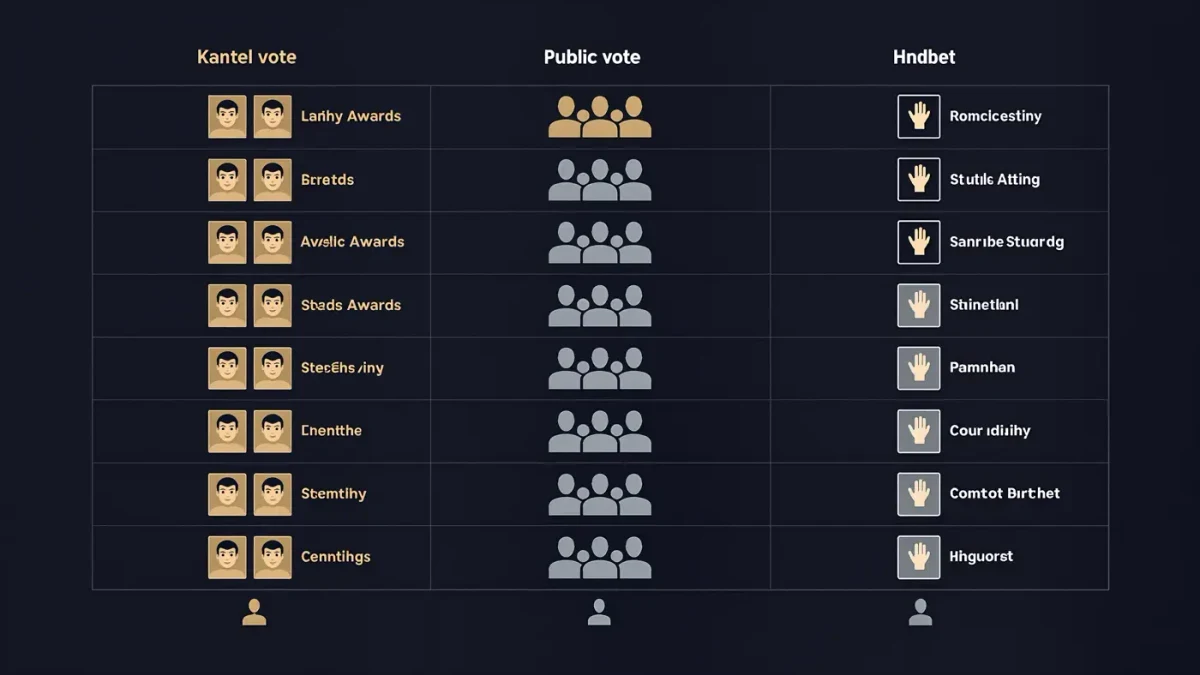
Two models dominate. Industry-and-media panel shows, in the tradition of classic sport awards, sell expertise and attract skepticism about insiderness. Public-vote shows sell engagement and attract skepticism about mobilized fanbases — the community that organizes hardest wins, which measures passion rather than merit. Most ceremonies blend the two, with fan votes weighted alongside panels, which inherits both objections simultaneously.
| Model | Strength | Standard criticism |
|---|---|---|
| Industry panel | Expertise, institutional weight | Insider politics, lag behind public opinion |
| Public vote | Engagement, accessibility | Organized fan campaigns decide outcomes |
| Hybrid weighting | Legitimacy compromise | Both critiques, applied at once |
The table reads as cynical; the reality is just unsolved. Nobody has designed a voting system for a multi-title global scene that fans consider fair, because fair may not exist at this compression level.
How do players and teams campaign for awards?
Quietly, and increasingly openly. Because hybrid voting blends panel expertise with public ballots, a candidacy needs both: results that impress insiders and narrative that mobilizes voters. Organizations package highlight reels timed to voting windows, players give award-season interviews about their preparation and sacrifices, and communities organize get-out-the-vote pushes with the energy of a political campaign — pinned threads, reminders, translated instructions for international fanbases. None of this is unique to esports; sport has campaigned for honors forever. What is unique is the speed and the scale, since a global fanbase can move a public vote overnight in a way traditional sport's national audiences rarely matched.
The campaigning has a feedback effect on the season itself. Players know legacy narratives get written in year-end summaries, so award consideration joins championship qualification and contract value in the season's implicit incentive stack — a strong October is worth more than an equally strong May, and everyone plays accordingly. Ceremonies would deny shaping the competitive calendar; the calendar has noticed them anyway. The smartest fans treat the show as what it has always been: not a summary of the year but an argument about it, staged annually, with the community holding the real vote in perpetuity — every highlight comparison, every ranking thread, every rewatch that confirms or overturns the trophy's verdict years later.
Do the awards matter to players and orgs?
More every year, as the industry professionalizes. An award is marketing material, contract leverage, and sponsorship-deck copy — a line item in a scene where individual achievements are otherwise hard to certify. Players who once shrugged at ceremonies now campaign for them politely, and organizations incorporate hardware into branding. The awards' growing economic weight is also why controversies burn hotter: the argument is no longer only about memory, it is about money.
A trophy in esports is less a verdict than a prompt — the community finishes the sentence the ceremony started.
Could the format ever satisfy anyone?
Not fully, and smart organizers have stopped trying. The better ceremonies publish criteria, diversify voters, and lean into the argument as content — extended panels, debate formats, transparent shortlists — because the discourse week is worth more attention than the envelope. The lesson the format keeps relearning is that esports fandom does not want an authority; it wants a well-made claim it can argue with. Awards shows that embrace that role — conversation starters, record keepers, occasionally wrong on purpose-adjacent stages — endure. The ones that posture as definitive get eaten by the replies, annually, forever.