The gaming convention floor looks like it happened to people. Booths rise, panels fill, cosplayers parade, and everyone assumes the hall simply woke up that way. It didn't. Every expo floor is a months-long construction project that happens to end in a party.
So how does it come together? Slowly, and mostly out of sight. A show is planned the way a season is planned: a schedule set long in advance, a budget that decides what survives, and a crew of organizers, exhibitors, volunteers, and stagehands whose work is invisible precisely because it works. The word itself gives the game away. Merriam-Webster defines "behind" not just as a position at the rear but figuratively as what sits in the background of things — the conditions behind the strike, in its own example. Behind the scenes of gaming conventions is exactly that: the background conditions nobody photographs.
What follows is a look at how the machine runs, from the first floor plan to the last crate out the loading dock. It draws on how event operations work generally, not on any single show's private playbook — the broad mechanics are shared, even when the details differ.
When does planning for a convention actually start?
Far earlier than most attendees would guess. The big decisions — which hall, which weekend, how much space — are typically made a year or more out, because convention centers book their calendars that far ahead and the largest shows compete for the same prime weekends. Lock the date late and you don't get a worse venue. You get no venue.
From there, the work cascades. The organizer signs the hall, then sells exhibitor space, then maps the floor so that the loudest, hungriest booths don't swallow the aisles. Fire codes cap how many people can stand in any given square meter, so floor design is arithmetic before it is theater. Aisle width, exit placement, and booth density are all negotiated against a rulebook written by people who will never play a demo.
The exhibitors run their own parallel countdown. A studio showing a playable build has to hit a milestone months before the doors open, because a demo that ships to a convention has to be stable, curated, and safe from leaks. That's why the version you play on the floor often feels slightly different from what launches later — it was frozen while your game was still growing.
How does an expo floor physically get built?
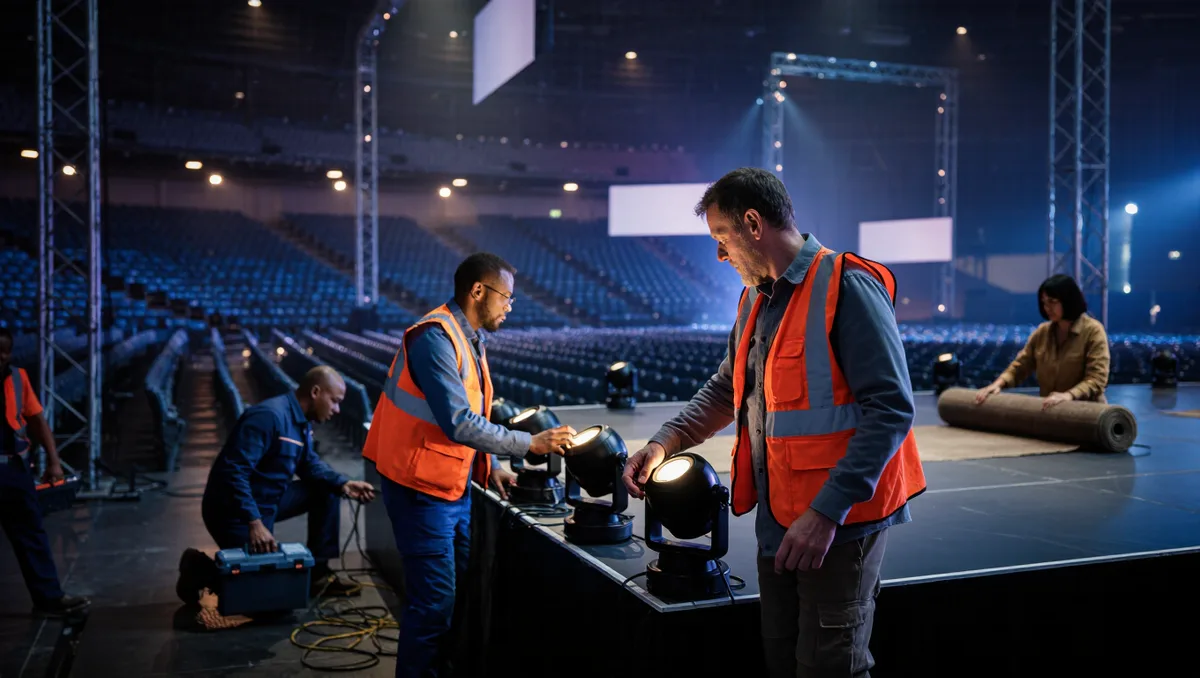
Fast, and in a strict order. Most venues are empty shells: concrete, columns, and overhead rigging points. In the days before opening, crews lay carpet and flooring first, then run power and network cabling under it, then assemble booth structures on top. The sequence matters. You cannot pull a cable through a finished booth, so the ugliest work happens first and the prettiest last.
The booths themselves are a hybrid. Exhibitors ship standardized modular pieces — walls, counters, light rigs — that assemble like very expensive furniture. Around them go the custom builds: the one-off stage, the oversized prop, the themed entrance. Those are designed, fabricated, and test-assembled at a warehouse beforehand, then shipped in pieces, because nobody discovers on the show floor that a beam doesn't fit.
Overhead does the heavy lifting visually. Riggers hang signage, lighting trusses, and screens from the ceiling structure, and every pound of it is engineered and signed off before it flies. A banner over a main stage is not decoration; it is a load-bearing calculation.
What makes a panel run on time — or fall apart?
Rooms, clocks, and people. Programming teams build the panel schedule months out, balancing big headline sessions against smaller community talks, then slotting each into a room sized for its realistic audience. The guesswork is the hard part: a panel expected to draw two hundred might draw forty, or queue around the corner. Organizers manage this with room reassignments, overflow lines, and, in bigger halls, streaming the session to a second room.
On the day, it runs on volunteers and moderators. Panel moderators keep speakers to time, wrangle microphones for audience questions, and enforce the basic etiquette that keeps a Q&A from becoming a monologue. Volunteers — often fans working for badges and access rather than wages — staff the lines, check badges, and relay problems. The convention's public face is polished; its nervous system is teenagers with radios.
When panels fail, it's usually for boring reasons: a missing adapter, a speaker stuck in another room, a video that won't play on the venue's projector. AV crews carry spares of nearly everything for exactly this reason. The smoothest panel you ever attended was saved at least once by someone swapping a cable you never saw.
How does a cosplay contest come together?
As a competition with real infrastructure. A contest needs a stage, a judging process, a backstage flow, and a schedule that fits inside the show's day — which means cosplay is planned with the same seriousness as any tournament bracket. Entrants register in advance, many shows require pre-judging (a sit-down review of craftsmanship before the stage walk), and the runway order is set so that costume changes and stage cues don't collide.
Backstage is where the real logistics live. Contestants need a place to suit up, repair damage, and queue in order. Handlers guide partially blind cosplayers down stairs and through curtain gaps. Judges score craftsmanship — seams, structure, paintwork — separately from stage presentation, which is why a costume that photographs beautifully can lose to one built better. We've covered how cosplay grew into its own competitive culture before, in our piece on cosplay at esports events, and the convention contest is where that pipeline starts.
What this means for attendees is simple: the contest you watch is the top of a pyramid of scheduling, safety planning, and volunteer labor that most of the hall never notices.
Who are the people actually running the show?
A layered crew, most of it part-time or temporary. At the top sits the event organization — the staff who own the budget, the venue contract, and the guest list. Beneath them, specialized contractors handle the trades: rigging, electrical, plumbing (yes, plumbing — every food court booth needs it), security, and cleaning. Beneath everyone, volunteers fill the gaps that paid staff can't cover at scale.
The exhibitor side has its own army: booth staff flown in from studios, product specialists who run demos, and road crews who travel the convention circuit booth by booth. Some of these people spend more of their year in convention halls than in offices. They have their own shorthand, their own war stories, and a professional pride in a floor that opens on time.
Our analysis: the culture of these crews deserves more attention than it gets. Fan communities study balance patches and roster moves obsessively — we've written about how fan communities argue balance patches into existence — but the labor that makes a thousand-person panel and a hundred-booth floor function at once gets almost none. It's the same instinct, pointed the other way: the people who show up early and stay late because the thing only works if they do.
What happens after the doors close?
The teardown, which is the build in reverse and slightly sadder. Booths come apart, crates get repacked, and the venue's shell reappears within a day or two. Damage gets assessed — scuffed floors and wall gouges are billed against deposits — and organizers hold a post-show review while memories are fresh, logging what lines failed, which rooms overflowed, and what to change next year.
Then the calendar turns over, and the next cycle begins. The convention you attend is a single performance of a production that never really ends; it just pauses between acts. The culture kings of the expo hall aren't the studios with the biggest booths. They're the planners and crews who make three days of controlled chaos look like it simply happened — and who will be back in an empty hall next season, laying carpet first.