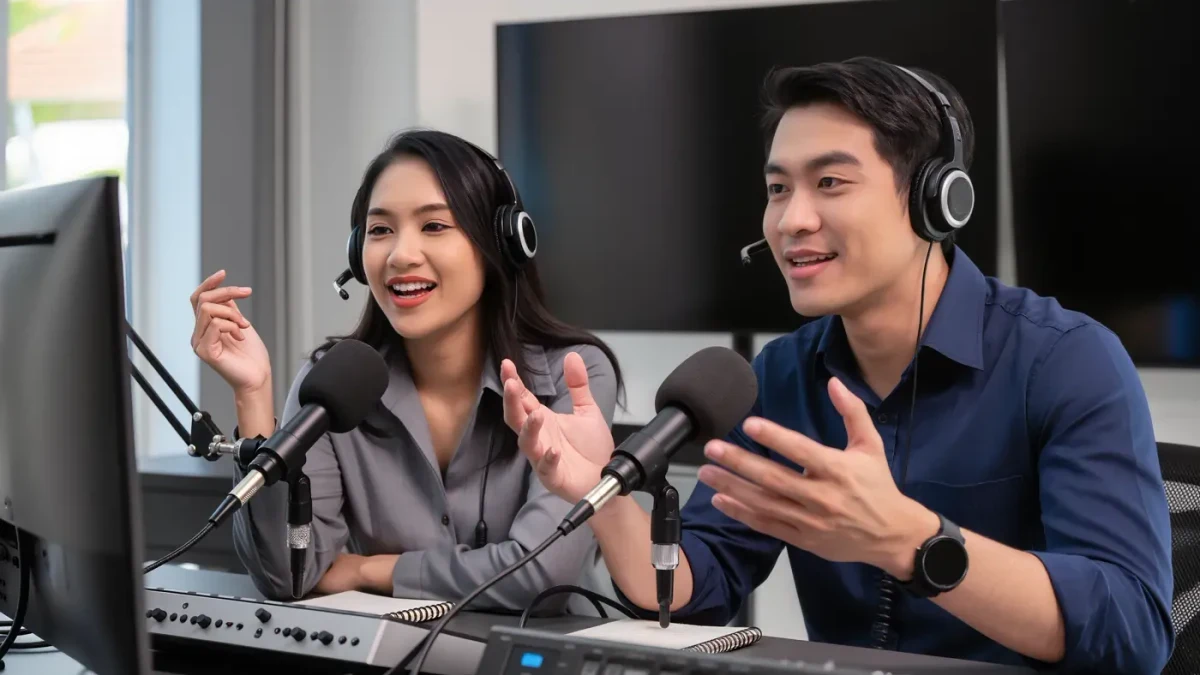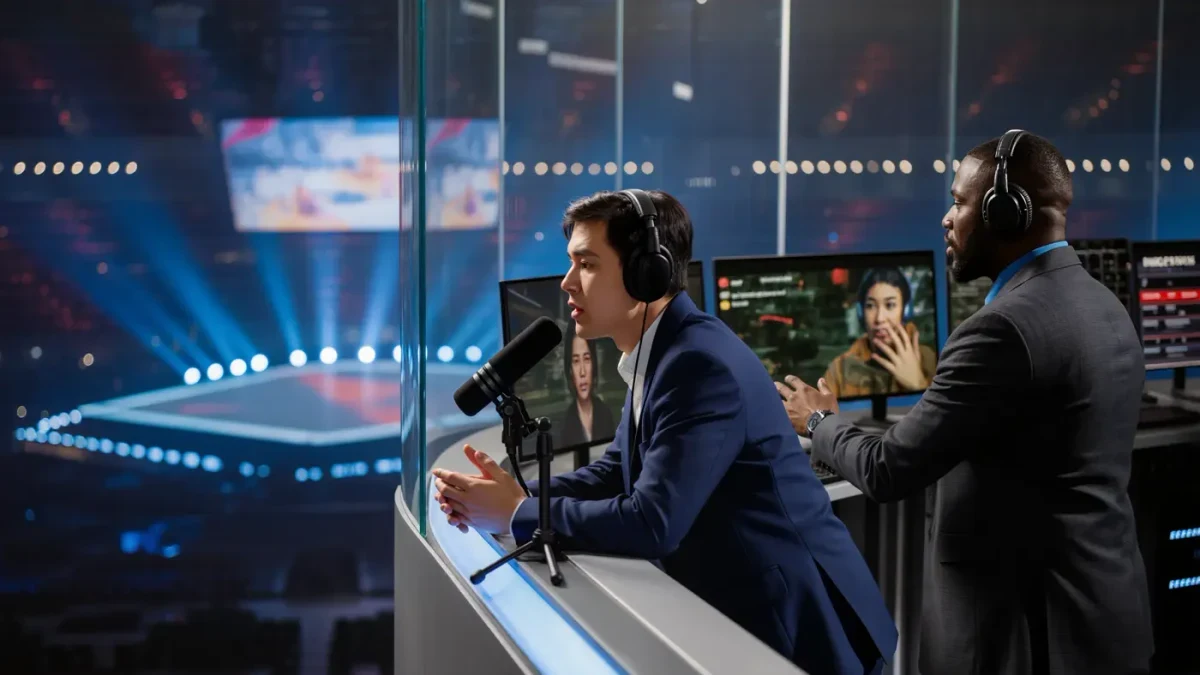
Esports casting works because it splits the job in two: one narrator calls the action in real time while a partner explains what it means, and that division of labor matches how viewers process a fast game. The model was borrowed from traditional sports radio nearly a century ago and adapted to games that run at three or four times the pace of football. When Faker won his fifth world championship with T1 in November 2025, per the league's official results, the moment landed for a global audience largely because two people in a booth framed it.
Academia Hagi is an independent online publication — not a TV station, streaming channel, or broadcaster — and casting is exactly the craft of talking over broadcasts made by others, so it is worth being precise about what we are describing. This is a culture piece about the language of commentary, not a review of any caster's performance.
What do play-by-play and color actually mean?
Play-by-play is the raw narration: who used which ability, where the rotation went, which team took the objective. Color is the interpretation layered on top — why a draft pick is greedy, why a timing window matters, why a player's positioning signals a trap. The play-by-play voice owns pace and urgency; the color voice owns meaning and history. Together they cover both halves of comprehension, and the best duos trade roles mid-fight without a word of visible coordination.
The split exists because speed demands it. A Counter-Strike round can resolve in under thirty seconds. A League of Legends team fight can swing on four abilities fired inside two seconds. No single voice can narrate the action and explain the stakes at that tempo, so the grammar of the booth became call first, explain second, and the audience learns to hear both tracks at once.
Why does the duo format beat a single voice?
A solo caster in a fast game must choose, moment by moment, between accuracy and context, and either choice loses something. The duo format removes the trade-off. When a color analyst pauses to explain what a control ward — the vision-denying item that quietly shapes map control in League of Legends — does for the twentieth time in a broadcast, the play-by-play voice keeps the game moving, and the viewer who already knows simply filters the explanation out.
This is the same trick sports radio refined decades ago: narrate for the newcomer, analyze for the veteran, and trust the listener to sort the layers. Esports inherited it through StarCraft broadcasts in early-2000s South Korea, where professional leagues put commentator pairs on televised matches and built the conventions — the rising pitch as a fight starts, the flat analytical read afterward — that global casting still uses. The lineage is direct, and you can hear it in every major title's booth today.
How did casting language become its own dialect?
Every competitive game generates a compressed vocabulary, and casting accelerates the compression. A phrase like "he's ulting" means nothing outside its game and everything inside it. Terms enter the dialect from player slang, get sanded smooth by casters, and settle into the standard broadcast lexicon: gank, eco round, objective trading, temp, shield break. New viewers learn the game partly by absorbing this dialect, which is why casting is the unofficial onboarding system for an entire scene.
- Gank — a surprise attack, usually from an unexpected angle, drawn from multiplayer slang older than most current pros.
- Eco round — a deliberately low-spend round in tactical shooters to save money for future buys.
- Tempo — the initiative pressure a team exerts on the map's clock, borrowed from chess commentary.
- Clutch — a lone player winning a disadvantaged situation, now so standard it names a statistic.
The dialect also does emotional work. Casting language is calibrated arousal management: flat and dry during a slow farming phase, then sharply amped as a fight breaks, then deliberately cooled for the post-fight read. Viewers rarely notice the engineering, but they feel it — the booth tells you when to lean in.
Why do the best casters talk about silence?
Because restraint is the hardest skill in the booth. A novice caster fills every second; a great one knows that a game-changing play sometimes deserves a beat of raw crowd noise before anyone speaks. The famous calls in esports history — the ones clipped and rewatched for years — are mostly short. The play happened, the voice named it, and the arena did the rest. Wordiness at peak moments is the mark of a booth that does not trust the game.
The best broadcast grammar assumes the viewer is smart, curious, and new, all at once — and never apologizes for any of the three.
That assumption is also why the register avoids gatekeeping. Good casters gloss terms in passing rather than lecturing, and they explain for the hundredth viewer with the same tone as for the first. A scene that wants to grow cannot afford a booth that sighs at questions.
How has streaming changed the booth?
Two shifts, one obvious and one subtle. The obvious one is volume: where a 2005 StarCraft league needed a handful of casters, the streaming era needs thousands, because every tier of every region is now broadcast somewhere. Casting stopped being a scarce network job and became a craft with an amateur ladder of its own, from community streams to tier-one leagues.
The subtle shift is that streamers compete with the booth. A viewer watching a top player's personal stream hears a third kind of commentary — unfiltered, personality-first, often funnier than the official feed — and official broadcasts have responded by loosening. The modern tier-one booth riffs, jokes, and references community memes, because the alternative is sounding institutional next to a creator economy that does not. The grammar survived; the tone relaxed.
Does casting actually affect how we judge players?
More than most fans admit. Commentary frames narratives — who is a genius, who is choking, which draft was greedy — and those frames outlive the matches that created them. A caster who repeatedly frames a player as inconsistent hands the community a storyline it will apply for years. The booth is not neutral; it is the scene's memory in real time, and casting language is how that memory gets written.
This is why organizations and leagues treat commentary as a product surface, not an afterthought. The people in the booth decide whether a casual viewer becomes a fan, whether a complicated game reads as chaos or as sport, and whether the dialect welcomes newcomers or walls them out. The language works because it was built, deliberately, by decades of broadcasters solving the same problem: a game too fast for one voice, and an audience that deserves both the call and the meaning.